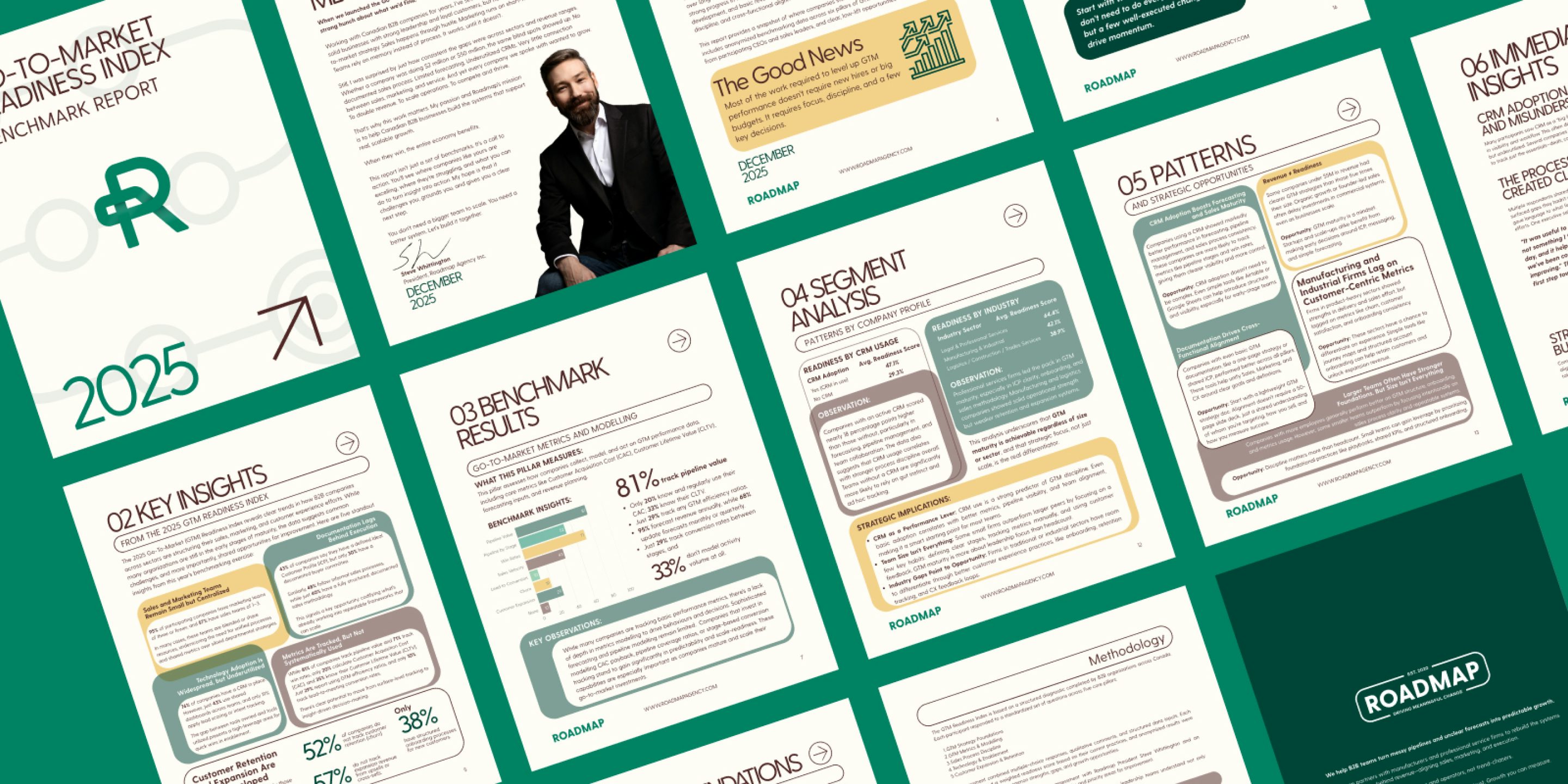
What the Go-To-Market Readiness Index Reveals About How B2B Companies Grow
Explore findings from the 2025 Go-To-Market Readiness Index and see how B2B leaders are strengthening strategy, metrics, and revenue predictability.
Over the past few months, we’ve been running the Go-To-Market Readiness Index with B2B companies across Canada as part of an ongoing research initiative.
Those conversations shaped our recent podcast episode with Christie Hewlko, who led the research behind the 2025 GTM Readiness Index. In the episode, we reviewed what emerged as leadership teams examined how their go-to-market systems are structured today.
Leadership teams came from different industries, operated at different revenue levels, and carried different growth ambitions, yet they surfaced remarkably similar challenges as they examined their go-to-market systems. As Christie put it, “Regardless of their industry or size, the same types of themes kept showing up.”
That is exactly why we built the Go-To-Market Readiness Index.
What the Go-To-Market Readiness Index Is
The GTM Readiness Index is a structured diagnostic designed to help leadership teams understand how mature their go-to-market system is today and what it is capable of supporting next.
It provides a grounded framework for evaluating sales, marketing, and customer experience as a single system, using shared definitions, metrics, and benchmarks. The outcome is not just a score. It is a common language leaders can use to align teams and make decisions based on data rather than opinion.
As Christie said about the research, one of the biggest surprises was how much clarity leaders gained simply by going through the questions. “We had people say, ‘I didn’t even realize that was a gap until I saw the question.’”
The Index measures five core components.
1. Go-To-Market Strategy Foundations
This component assesses whether a company has clearly defined who it serves and how it wins. That includes Ideal Customer Profile (ICP) clarity, buyer roles, positioning, and alignment between sales, marketing, and customer teams.
One of the early findings Christie highlighted was how often this foundation exists informally. Only 29% of companies have a documented go-to-market strategy, even though execution is well underway. About 43% report having a defined ICP, yet only 30% have documented buyer committees, which creates friction as teams try to scale lead qualification and messaging.
This pattern reflects a common dynamic in growing B2B companies: strategy exists through experience and relationships, but not always through documentation. As teams expand, that informal alignment becomes harder to sustain and easier to interpret differently.
2. Metrics and Modelling
This component looks at how companies use numbers to guide decisions, forecast revenue, and prioritize effort.
As Christie explained, many teams have access to data, but they are not modelling it. The benchmark reflects that. While over 80% track pipeline value and 71% track win rates, only 20% calculate Customer Acquisition Cost, and just 35% know their Customer Lifetime Value. Fewer than a third track GTM efficiency ratios.
The data shows strong visibility into activity metrics like pipeline and win rates, with a clear opportunity to strengthen decision-making metrics that guide investment and growth priorities.
3. Sales Process Discipline
This area evaluates whether sales activity follows a defined, shared process that supports consistency, coaching, and forecasting.
Only about one-third of companies reported that reps consistently follow a documented sales process, even though three-quarters hold regular pipeline reviews. As Christie said, the fastest improvement often comes from documenting the process teams are already using and operationalizing it in the CRM.
That step alone creates consistency, visibility, and a foundation for coaching.
4. Technology and Enablement
This component looks at how tools support execution and habits.
The research showed that 76% of companies have a CRM, but only 43% use shared dashboards, and just 19% apply lead scoring or intent tracking. From the research, we can infer that technology adoption is not about feature depth. It is about using tools in a way that matches a team’s maturity and reinforces disciplined behaviour.
The insight here is that tools don’t create discipline; they reflect it. When technology is adopted in line with a team’s maturity, it reinforces the habits leaders want to see. When it’s not, it adds complexity without changing behaviour.
5. Customer Expansion and Retention
This final component focuses on post-sale systems such as onboarding, retention tracking, and account growth.
This was one of the clearest blind spots in the research. Only 38% of companies have a structured onboarding process, 57% do not track expansion revenue, and just 19% formally track customer retention. As Christie noted, this is often a result of how teams are incentivized. When compensation focuses on acquisition, expansion and retention receive less structure.
One of the highest-leverage opportunities in the entire go-to-market system shows up after the deal closes. Small improvements in how customers are onboarded, retained, and expanded compound over time and directly influence revenue stability, margins, and planning confidence.
What This Means for Leadership Teams
One of the most important takeaways from both the research and the podcast is that go-to-market maturity is not a function of company size.
As Christie said, “It’s not about size. It’s about discipline.”
Smaller teams often outperform larger ones because they focus on documenting what works, tracking a small set of actionable metrics, and aligning on shared goals.
The GTM Readiness Index grounds go-to-market conversations in data and structure, giving leadership teams a tangible way to align and move forward.
How Leaders Are Using the Index
Many leaders told us that the diagnostic itself created clarity. It helped them see where they had been relying on experience and habit, and where a small amount of structure would generate momentum.
That is why we describe the Go-To-Market Readiness Index as both a mirror and a map.
A mirror that shows where your go-to-market system stands today.
A map that outlines what to focus on next using data.
How to Get Involved
We’re continuing this research because the conversations and benchmarks deepen our understanding of how B2B go-to-market maturity is evolving, particularly for traditional B2B companies that have been underserved by existing frameworks and tools.
If you lead a Canadian B2B company and qualify to participate, you can complete the Go-To-Market Readiness Index, receive your own individualized Benchmark Report, and receive a grounded, data-driven view of your go-to-market system.
The goal is alignment, and the outcome is more predictable revenue built on systems leaders can see, measure, and improve.
Learn More Here

Check Out Our Podcast
Podcast Season 2 Episode 03: Is Your Go-To-Market Ready to Scale? Inside the 2025 Go-To-Market Readiness Index
The full findings and context behind this research are discussed in detail on the Driving Growth podcast.
Would you like us to implement a similar strategy for you?
Book a Discovery Call