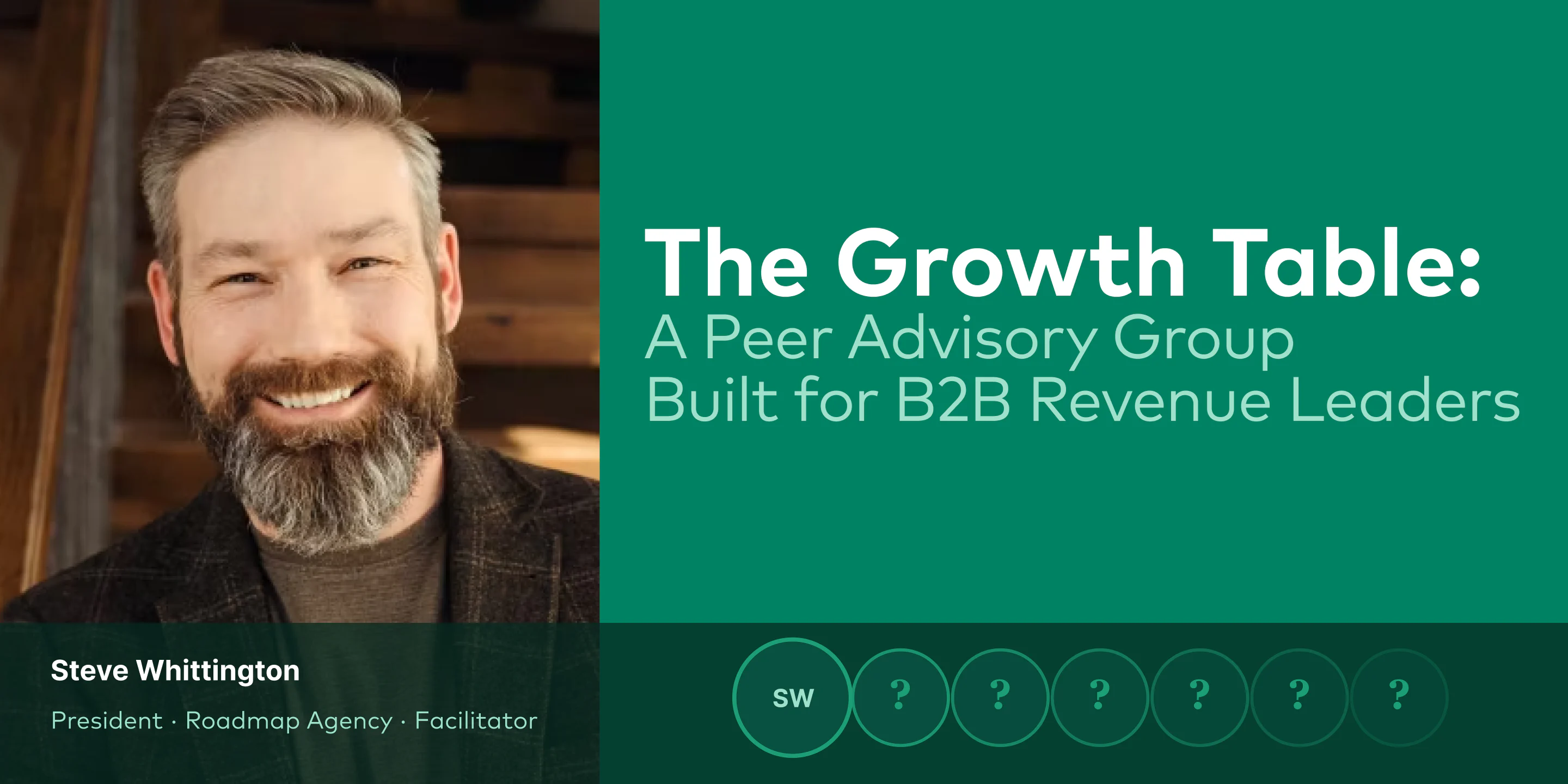
The Growth Table: A Peer Advisory Group Built for B2B Revenue Leaders
Revenue leaders carry more pressure than almost anyone in a B2B organization and have fewer places to turn. The Growth Table is a peer advisory group built specifically for them.
TL;DR
Revenue leaders in B2B organizations carry enormous pressure, and most of them carry it alone. There are no forums built specifically for them. No peer communities that speak their language. No safe place to work through the real challenges without fear of giving away competitive advantage.
This article covers why that gap exists, why it matters, and what the Growth Table does about it:
- Why revenue leaders are under more pressure than ever, and why solving growth problems alone is the default, not the exception
- Why growth has always been a systems problem, and what that means for how revenue leaders need to think and operate today
- Why a peer advisory group outperforms individual coaching for revenue leaders
- Who the Growth Table is built for, what a session looks like, and what it costs
- How to calculate the ROI of joining before you decide
Revenue leaders are the most pressured people in most B2B organizations. Everyone has an opinion on the number. Very few understand the complexity, the cycle length, or the pressure that comes with being the person responsible for making it happen.
And it is exactly why we built the Growth Table.
What the Data Says About the State of B2B Sales
Revenue leaders are operating in one of the most difficult selling environments in recent memory:
- The Canadian Professional Sales Association (CPSA), a 150-year-old institution, shuttered its doors.
- According to Ebsta x Pavilion’s 2025 GTM Benchmarks, 78% of sellers missed quota in 2024, and Salesforce’s State of Sales research finds 67% of reps did not expect to hit it that year.
- The Sales Health Alliance’s 2024 State of Mental Health in Sales report, a Canadian organization tracking mental health across the sales profession, found 70% of salespeople say they are struggling with their mental health.
- And at the same time, the tools available to sellers have multiplied, which, counterintuitively, has made things harder, not easier.
Here is what I mean.
When it used to take three to six touches to move a deal forward, outreach was manageable. Now, in many cases, it takes 16 to 21 touches to get the same result.
Why? Because technology has made it easier to reach buyers, which means every buyer is being reached by more sellers, which means resistance has gone up. The market is saturated with outreach. Breaking through requires more effort.
And beyond that saturation, there is the economic environment.
When uncertainty is high, the default decision for buyers is to do nothing. Status quo feels safer than change. That may be exactly the wrong instinct for their business, but it is the one showing up in pipelines everywhere.
Revenue leaders are working twice as hard to get half as much. And most of them are doing it alone.
Why Revenue Leaders Tend to Solve Growth Problems Alone
It is not ego. It is not culture. It is the simple fact that almost nobody else in the room knows how to sell.
Everyone is telling revenue leaders what the numbers need to be. Very few understand the time it takes, the complexity involved, or what is required to build a strong sales pipeline in a modern B2B market. That isolation is not a choice. It is the default condition.
Add to that the fear of competition: the concern that sharing real challenges with peers means giving away your edge. The result is a situation where the people who most need outside perspective are the least likely to seek it.
That is the problem the Growth Table is designed to solve.
Growth Has Always Been a Systems Problem
This is not a new observation. I was using the term “smarketing” in the 2000s to describe what happens when sales and marketing operate independently instead of as a unified revenue system. Today we call it revenue operations. The terminology has changed. The underlying problem has not.
Marketing has always had a tendency to march to its own drum. Sales has always done its own thing. The result is an organization where the people responsible for revenue are not working from the same system. They are running parallel activities and hoping they add up.
The good news is that awareness of this problem is improving.
More organizations are recognizing that revenue requires a unified system, and not a collection of disconnected functions.
But awareness alone does not fix the execution. Revenue leaders still need to build and run that system, often with limited support and constant pressure to perform.
Why a Peer Advisory Group Outperforms Individual Coaching
Individual coaching has value. But why have one coach when you can have seven?
When you bring together a group of revenue leaders who are actively working through similar challenges, you get diverse perspectives from people with real skin in the game. You get solutions that have been field-tested. You get the experience of being understood.
The peer advisory model also creates accountability that individual coaching cannot replicate. When you make a commitment to a group of peers, follow-through is more likely to happen.
This model is proven. It has worked in CEO peer groups for decades. Revenue leaders have never had a version built specifically for them.
What the Growth Table Is and Who It Is For
The Growth Table brings together small groups of revenue leaders from non-competing B2B companies to work through the challenges of delivering growth. Through structured monthly sessions, members share experience, pressure-test decisions, and improve the systems behind revenue generation.
It is designed for leaders responsible for between $5M and $50M in revenue who sell into other businesses, whether directly, through dealer networks, or through other B2B account structures. The members it is built for include:
- VP of Sales — senior leaders responsible for team performance, forecasting, and revenue delivery across complex B2B sales cycles
- Sales Directors — directors managing sales teams and processes who need peer insight to improve consistency and results
- Revenue Leaders — leaders with broad revenue responsibility across sales, marketing, and customer success
- Owner-Operators Responsible for Sales — business owners who carry the revenue mandate directly and need a structured peer group to think through growth challenges
You may have a team reporting to you, or you may be the sole revenue leader working with outside partners. What matters is that you are accountable for the number and operating in a B2B environment.
This is not for B2C. The sales cadence, cycle length, and dynamics are fundamentally different. The Growth Table is focused entirely on B2B.
And every member of a cohort is in a non-competing company. The goal is open, honest conversation, and that requires removing the competitive dynamic entirely.
What Happens in a Growth Table Session
Every session follows a structured format designed to deliver immediate and lasting value. There are 10 facilitated sessions per year, each built around the same four-part structure:
- Education Segment — discussion on a key revenue leadership topic relevant to current business conditions, led by a revenue coach or subject matter expert
- Member Sharing — each participant shares current challenges and what they are seeing in their markets
- Problem Solving — members bring real issues; the cohort works through them together
- Takeaways and Actions — members leave with practical ideas and clear next steps to implement
Each cohort is 5 to 7 revenue leaders, enough to generate genuine diversity of perspective but few enough that every voice gets heard and every challenge gets real attention.
The investment is $295/month all-inclusive. Frameworks, tools, and peer sessions are all covered in a single fee.
What You Get That You Cannot Get Anywhere Else
A group of trusted advisors who understand what it takes to run a modern go-to-market system.
People who speak the same language.
People who have been in the same situations and come out the other side.
One of the most immediate benefits members experience is the clarity that comes from building and reviewing a revenue scorecard together.
Seeing the levers of your business in one place, understanding where the gaps are, where the momentum is, and what the numbers are actually telling you, creates a kind of objectivity that is hard to access when you are inside the problem every day.
Beyond that, there is confidence that comes from knowing you are not alone. From knowing that other experienced revenue leaders are working through the same challenges. From being able to go back into your own organization with more language, more context, and more conviction about what needs to change.
That is not a soft benefit. That is a force multiplier.
How to Decide If the Growth Table Is Worth the Investment
Revenue leaders are wired to think in terms of return. So use that instinct here.
Think about one problem you are currently facing. A deal stuck in the pipeline. A team misalignment that is costing you closes. A forecasting model that has been wrong three quarters running. A market that has shifted and a go-to-market approach that has not kept up.
Now think about what solving that problem is worth to your organization.
If the value of solving that one problem, in revenue protected, revenue created, or time and resources saved, exceeds the $3,540 annual investment, you have your answer.
That is the math. It is not complicated. But it requires being honest about what your current problems are actually costing you.
If the ROI is not there, do not join. The Growth Table is for revenue leaders who are ready to bring real challenges and take real action. If you are not sure, run the numbers first. That will tell you what you need to know.


Apply to Join the Growth Table
Seats are limited to keep groups small and effective. If you are responsible for driving revenue in a B2B organization and you are done navigating the hardest parts of that role alone, the application takes less than five minutes.
Learn How to Build a Stronger Go-To-Market System
Explore the research and tools designed to help you understand where your go-to-market system stands and where to focus to support growth.


The Go-To Market Readiness Index
Roadmap developed the Go-To-Market Readiness Index to give B2B leaders a clear, objective view of how well their go-to-market systems support growth. Through a structured diagnostic, companies can benchmark performance, identify gaps across strategy, metrics, and execution, and define where to focus next.

The 2025 Benchmark Report
The 2025 GTM Readiness Benchmark Report brings together data from Canadian B2B companies to show how go-to-market systems are structured and where gaps most often appear. It gives leaders a clear view of how peers are performing, highlights common constraints, and shows where systems tend to fall short.
Would you like us to implement a similar strategy for you?
Book a Discovery Call