3D Supply Chain Solutions
The Infrastructure Behind Growth: A GTM System Built for a Fast-Moving Freight Forwarder
3D Supply Chain Solutions (3DSCS) is a Manitoba-based freight forwarding and contract logistics company. Operating across ocean freight, air freight, ground, warehousing, and customs brokerage, the company serves manufacturers, retailers, and distributors managing complex global supply chains. 3DSCS engaged Roadmap to help build the strategic, brand, and operational infrastructure needed to support their next stage of growth.

Our Role
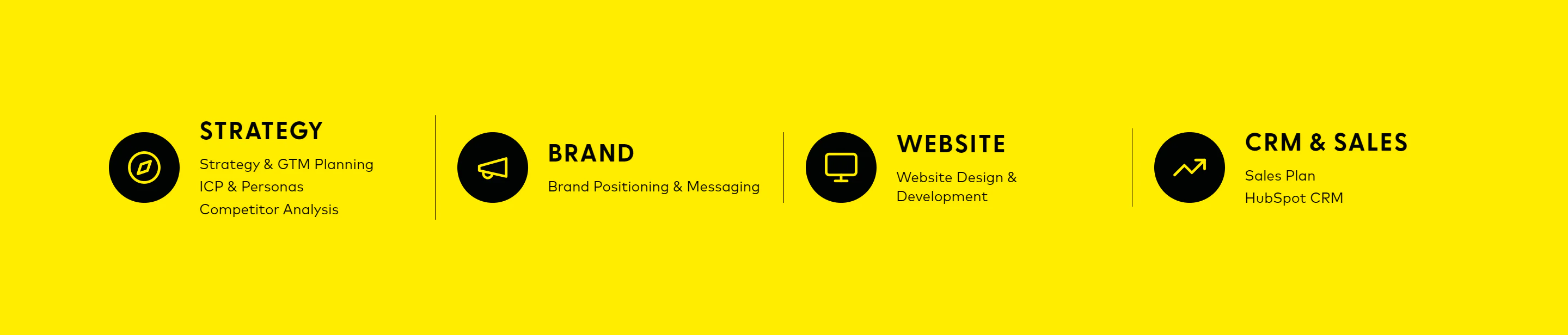
- Strategic Foundations and Go-to-Market Strategy
- Ideal Client Profile and Persona Development
- Competitive Analysis
- Brand Positioning and Messaging
- Website Design and Development
- Sales Plan Development
- HubSpot CRM Functional Requirements Document and Implementation
The Need
When 3DSCS came to Roadmap, they were growing fast — but almost entirely through reputation and relationships. Every new client had arrived through a referral or a reactivated connection. The company had no independent web presence, no formal brand positioning, no CRM, and no documented sales process.
Their goal was to evolve the business from a founder-led operation into a structured, scalable company capable of attracting direct clients and agent partners, supporting a growing team, and competing for business without relying solely on personal networks.
To get there, 3DSCS needed more than leads. It needed a clear market position, a website that could act as a credible sales tool, a CRM that could bring visibility to the pipeline, and a sales plan that turned a growth aspiration into a documented, manageable system.
The Challenge
The strategic work quickly revealed that while the business was performing well, almost none of its commercial infrastructure had been built yet.
There was no positioning. In a category where every competitor claims to offer global reach, reliable service, and tailored solutions, 3DSCS had no articulated point of view about what made it different — even though, in practice, the differences were significant. The company's responsiveness, cross-modal expertise, data discipline, and willingness to embed deeply into client operations all set it apart from both large enterprise forwarders and transactional competitors. None of that was visible externally.
The client base was concentrated and undocumented. There were no account tiers, no account management cadence, and no structured process for tracking or expanding existing relationships.
There was also no CRM. Some team members operated from memory — no deal tracking, no pipeline visibility, no structured follow-up process. As the team grew and the business complexity increased, this approach wasn't sustainable.
And there was no website. Without one, the company had no way to support inbound interest, communicate its positioning to new prospects, or give potential clients a place to evaluate the business before a conversation.
The Solution
1. Strategic Foundations and Go-to-Market Strategy
Roadmap began the engagement with a structured discovery phase to establish the strategic context needed to guide all the work that followed. This included a review of the company's current market position, growth trajectory, and go-to-market approach. The output of this phase informed all other work, to ensure everything was grounded in the same strategic foundation rather than developed in isolation.
2. Ideal Client Profile and Persona Development
Roadmap worked with the 3DSCS team to map their client base and identify the most valuable segments to pursue. Two core ICPs emerged, as well as distinct buyer personas — including the senior supply chain decision maker, and the logistics and transportation manager responsible for day-to-day execution.
Each persona was built out with pain points, motivations, how they find and evaluate providers, and what sells them on a partner versus a transaction. This work became the foundation for the messaging, website, and sales plan.
3. Competitor Analysis
Roadmap analyzed a set of direct and aspirational competitors across brand identity, positioning, messaging, website experience, and social presence. The findings confirmed a significant gap in the market: most competitors defaulted to the same table-stakes language without substantiating any of it. Few connected their claims to tangible outcomes. Fewer still invested in proof.
These findings directly shaped the brand positioning work, identifying clear opportunities for 3DSCS to stand out by leading with specific, defensible differentiators rather than generic capability claims.
4. Brand Positioning and Messaging
Roadmap developed a complete brand positioning foundation, translating the strategic and competitive work into a structured identity.
Four core differentiators were identified and articulated:
- Communication that reduces risk — fast, direct, proactive updates that prevent problems rather than explain them after the fact, backed by well-maintained, decision-grade data
- A holistic view beyond logistics — understanding how freight decisions affect procurement, manufacturing, staffing, and cash flow, not just how freight moves
- Flexible problem-solving — the ability to pivot quickly, make decisions without escalation, and adapt solutions to the client
- Embedded partnership — acting as an extension of the client's team, reducing internal headcount needs, and building toward long-term efficiency rather than transactional volume
These pillars informed a positioning statement, core messaging frameworks, brand personality guidelines, and tailored messaging for each persona.
5. Website Design and Development
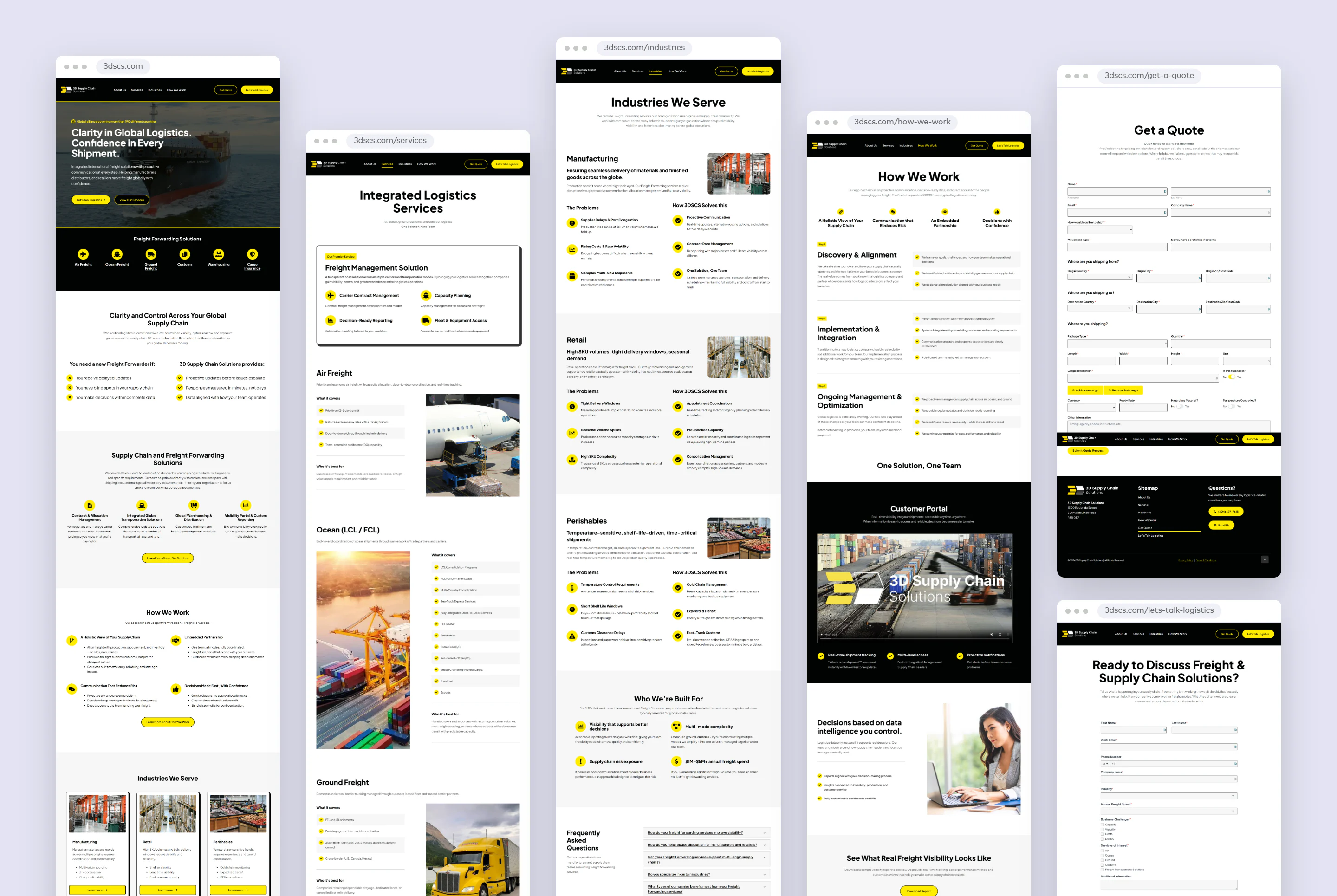
With the brand foundation in place, Roadmap built a new WordPress website, the company's first independent digital presence. The site was structured around five core pages: homepage, services, industries, how we work, and two distinct contact pathways for quote requests and discovery conversations.
The content was written to answer within seconds who 3DSCS is, what they do, who they serve, and what sets them apart. Key features included service pages with use-case framing, an industry section with pain-point-led messaging, a How We Work page anchored to the four brand pillars, and a gated report download to capture leads and demonstrate the company's data capabilities. FAQ sections were included on every page to serve both readers and search. All lead capture forms were integrated with HubSpot, and Google Analytics was configured for traffic and conversion tracking.
6. Sales Plan Development
Roadmap led a structured sales audit and planning process to translate the revenue target into a documented, actionable plan. The work began with a mathematical model — mapping the existing account base by tier, estimating annual contract volumes, and identifying exactly what account acquisition and expansion activity was needed to hit the goal.
The model showed that the primary lever wasn't new account acquisition; it was protecting and growing the existing strategic account base while upgrading several growth accounts to the next tier. The plan documented two distinct sales pipelines, a founders' network inbound motion, quarterly revenue projections scaled to the contract cycle, a Tier 1 account management cadence, and a near-term hiring roadmap that prioritized operational capacity before business development.
7. HubSpot CRM Functional Requirements and Implementation
Roadmap developed a Functional Requirements Document prior to implementation, defining pipeline stages, segmentation logic, and reporting requirements based on 3DSCS's actual sales process — a mix of annual contracts, spot quotes, and contract logistics accounts.
The implementation included a six-stage sales pipeline designed from the buyer's perspective, deal structure calibrated to annual contract volume, account tiering logic to support prioritization, Outlook email logging and tracking, lead capture form integration from the website, and an automation sequence for report downloaders that triggers a follow-up task and notification. An email template and snippet library was configured for high-frequency communications, and contact list management was established within the plan's limits.
The system was built to give the founding team immediate visibility into the pipeline and contracted volume and to scale as staff were added.
This process forced us to focus on aspects of the business that we would never have taken time to address otherwise. We now have a real foundation — not just for where we are, but for where we're going.
The Results
The engagement produced 3DSCS's complete go-to-market system — moving the company from a founder-dependent operation to one with documented positioning, a functioning digital presence, a CRM and a sales plan tied to real projections.
Strong and Unique Brand Positioning
3DSCS now has a clear, differentiated market position built around communication, embedded partnership, and cross-modal expertise — none of which the competitor set was articulating in any substantive way. The brand voice, tone guidelines, and persona-specific messaging frameworks are deployed across the website, sales collateral, and content going forward. When a new team member joins, or a business development hire comes on board, the playbook exists.
Optimized Digital Presence
The website is 3DSCS's first independent digital presence — and the first time the company can point a prospect somewhere before or after a conversation. A strong website doesn't just capture leads; it validates the business, communicates expertise, and does the work of building credibility before anyone picks up the phone. For a company that has won business almost entirely through relationships, having a professional digital presence that reflects the quality of the work is a meaningful step forward.
Visibility into Pipeline
For the first time, the team has visibility into the pipeline, contracted volume, and account-level activity — creating the foundation for account management at scale. As the business grows and additional staff are brought on, the CRM means that knowledge doesn't live in one person's head. Relationships are documented, follow-ups are tracked, and the business becomes less dependent on any single individual to hold it together. That's the kind of infrastructure that makes scaling possible without dropping the service standard that built the company in the first place.
Usable Sales Plan and Growth Trajectory
Going into the new fiscal year, 3DSCS entered contract season with a documented plan, clear account tiers, a defined management cadence, and a model for what the business needs to look like at the next stage of growth. For a company that had been growing without a lot of operational processes, having that structure in place changes how decisions get made — and makes it possible to evaluate whether the business is on track rather than simply reacting to whatever arrives next.
From Startup to Scalable — We Can Help You Get There
If your business is generating real traction but still running on relationships and intuition rather than systems, Roadmap can help you build the infrastructure your growth requires.
From brand positioning and website development to CRM implementation and sales planning, we work alongside teams to build the foundation that makes scaling possible.
Let’s Get Started